
7 juli, 2026
This year’s NSWO’s Spring Symposium took place at Amsterdam UMC with the title: “Anatomy of Sleep.” The day brought together clinicians and sleep researchers for a morning of talks on the neural and evolutionary underpinnings of sleep, followed by an exciting afternoon hands-on anatomy practical.
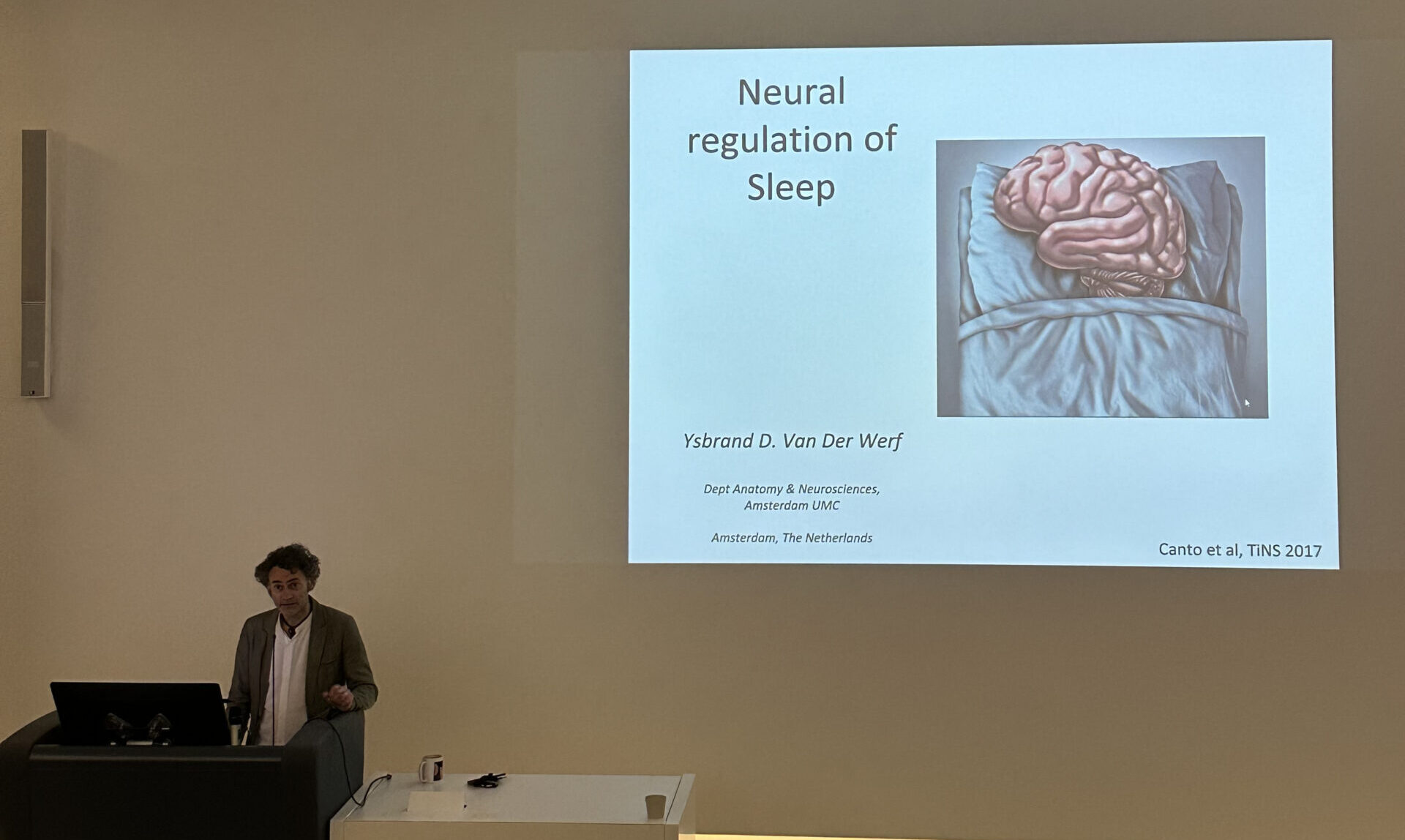
The morning kicked off with prof. Ysbrand van der Werf, who took the audience along on some of the more basic underpinnings of sleep, including the anatomical structures and neurotransmitter systems that regulate sleep and its different stages (and reminded us all that we should already be familiar with the contents of his talk!). He showed how interesting sleep can be across the animal kingdom, with glass frogs and sperm whales (who sleep vertically!) as memorable examples. His talk was a good preparation for the practical later in the afternoon.
Next, prof. Roelof-Jan Oostra took a deep dive into the evolutionary relationship between the retina and the pineal gland, which plays a central role in melatonin production and release. The two structures share a similar developmental origin, and in some animals (such as lizards and amphibians), the pineal gland still sits atop the brain beneath a thin layer of skull and is itself light-sensitive, earning it the nickname “third eye.” Although Roelof-Jan admitted that he did not know much about sleep himself, his lecture showed how the role of the pineal in sleep is intertwined with anatomy and evolution!
After the coffee break (that unfortunately lacked some coffee), dr. Alejandro Osorio Forero discussed the mechanisms underlying EEG activity and how the cortex and thalamus orchestrate slow wave sleep, delta activity, and sleep spindles. We should remember to define “slow wave activity” carefully, because slow oscillations and delta activity might have different neural underpinnings! Lastly, several early career researchers from the Anatomy and Neurosciences department pitched their ongoing sleep research: spanning from REM-sleep behaviour disorder in Parkinson’s, to central disorders of hypersomnolence, to sleep in post-traumatic stress disorder.
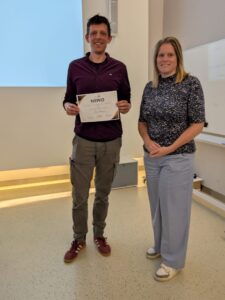
After the interesting talks, the NSWO Early Career Grants were awarded. With these grants the NSWO stimulates and supports early career researchers to present scientific work at conferences, to visit a lab abroad, or follow a sleep-research related course. We would like to congratulate this year’s recipients: Tom Bresser & Luisa Epifani! Following lunch combined with the General Members Assembly (ALV), attendees rolled up their sleeves for a hands-on anatomy practical. Split up in small groups, participants were able to dissect human brains and search for the anatomical structures from the morning lectures. In the end and with professional guidance from the anatomy department, all participants were able to see the structures that are vital for regulating sleep (even the tiny structures in the brainstem like the locus coeruleus!).
The day concluded with a well-deserved “borrel”, reconnecting with colleagues and discussing the exciting day. A huge thanks to all those involved in the organization of a successful Spring Symposium (in particular, the Education Committee and Early Career Scientists)!