
18 december, 2025
For NSWO members the second day of SLAAP started early with the general assembly at 8am. Denise Bijlenga stepped down as chair of the science committee and will be succeeded by Raymond Noordam. Furthermore Mink Schinkelshoek stepped down from the education committee, Emma van Andel and Dirk Jan Stenvers were reelected for the science committee and Danique Zantinge was elected to join the early career scientists.
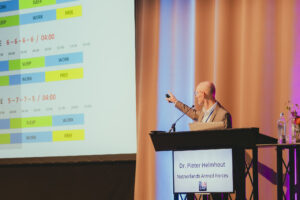
The official programme was opened with a keynote on Warfighter fatigue management by dr. Pieter Helmhout from the Brain Research and Innovation Centre. Military personnel can be exposed to extreme conditions with limited sleep opportunity which results in a combination of physical fatigue, cognitive fatigue and circadian disruption. The lecture gave interesting insights into sleep research in this field and how military personnel are prepared. In addition to the science it was fun to learn that in the military they have actual power nap training, but also: they really really love their coffee. Following the keynote was a new poster blitz round to spark interest and kickstart scientific discussions at the poster area.
The morning parallel sessions of Friday covered a variety of topics covering nerve stimulation for sleep apnea, interventions targeting the circadian clock, REM-sleep behavior disorder and clinical sleep research. We learned about the relevance of exercise timing and the challenges of personalized sleep & nutrition intervention in Dutch dock workers.
After the lunch break visitors had to choose, again, between excellent parallel sessions on circadian disruption and metabolic disorders, enhancing psychological treatment for insomnia, polysomnography and beyond or, the role of sleep disorders in psychiatric disorders. In this last session, our very own Ploon de Potter presented her work on the influence of sleep directly following PTSS treatment. Denise Bijlenga ended the psychiatric disorders session presenting the first results of the Sleep & Psyche pilot initiative, which provides advisory support to clinicians managing cases involving comorbid sleep and psychiatric disorders. Closing the gap between knowledge and implementation was a recurring theme during other sessions at SLAAP2025, as well.
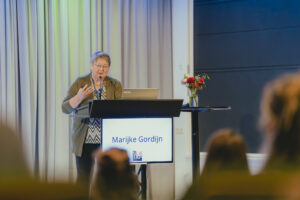
This challenge was nicely demonstrated during a talk by dr. Marijke Gordijn. After giving a scientific overview on the importance of the circadian rhythm, she reminded the audience that we had been inside for almost two days with limited light exposure despite all our knowledge on the topic. To practise what we preach, chair Dirk Jan Stenvers proposed that we open the blinds to enjoy more lux during the rest of the session.
Despite the dance-fatigue kicking in from the previous night, the afternoon sessions were well visited with high-quality presentations. Topics included sleep health in young children, how animal research informs somnology, intrinsic circadian rhythm disorders and difficult to treat obstructive sleep apnea. At the end of two intense but inspiring days, SLAAP2025 was concluded with some deserved drinks during the award ceremony.
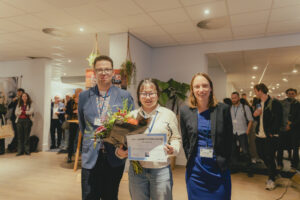
Out of 51 posters, the Piet Visser poster prize was awarded by the jury to Jingru Zhou for her poster on “Corticotropin-Releasing Hormone (CRH) in Murine Narcolepsy: What Do Genetic and Immune Models Tell Us?”. The audience poster prize was awarded to Miriam van der Velde for the poster titled “The Quiet hours? Observing Nighttime Life and Factors Affecting Sleep in Geriatric Care Settings”.
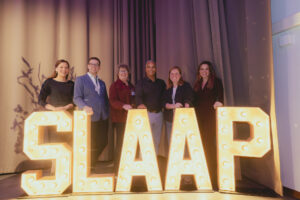
SLAAP2025 was well visited and proved to attract high-level clinicians, researchers and other sleep-professionals for an innovative and interactive two days.
We would like to thank the organizing committee Dr. Raymond Noordam, Dr. Jerryll Asin, Drs. Karin van Rijn, Drs. Pauline van Hirtum, Dr. Merel van Gilst and of course Annick Goijarts!
written by Tom Bresser